About AdBlue
What is AdBlue®?
AdBlue® is a highly purified colourless liquid. It contains demineralized water and urea (32.5%). It is used with diesel engines and is also known outside of Europe as DEF, ARLA 32 or AUS 32 in some countries.
The main active component of AdBlue® is ammonia. This is chemically formed by hydrolysing automotive urea, which is the main raw material for AdBlue®. Urea is also used in the production of fertilizers and many more applications.
AdBlue® is used with diesel engines using SCR technology. This technology (Selective Catalytic Reduction) reduces harmful emissions (NOx). AdBlue® is injected into the catalyst of the SCR system, where it triggers a chemical reaction with the ammonia. This chemical reaction converts the toxic nitrogen oxides (NOx) into nitrogen (N2) and water vapour (H2O). Water vapour and nitrogen are naturally occurring gasses that are harmless to the environment.
Here is a short video about AdBlue® –
How GreenChem ensures the quality of AdBlue?
GreenChem produces AdBlue in various blending sites across Europe and Brazil. GreenChem has subsidiaries in 16 EU countries which provide local sales & support to our customers.
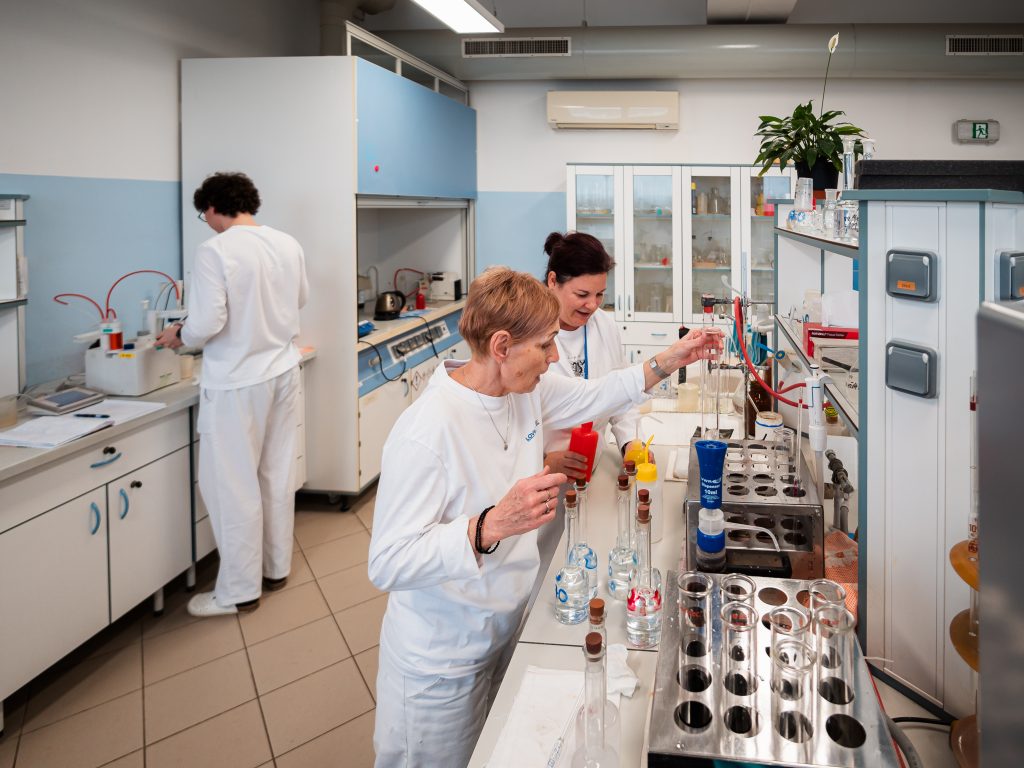
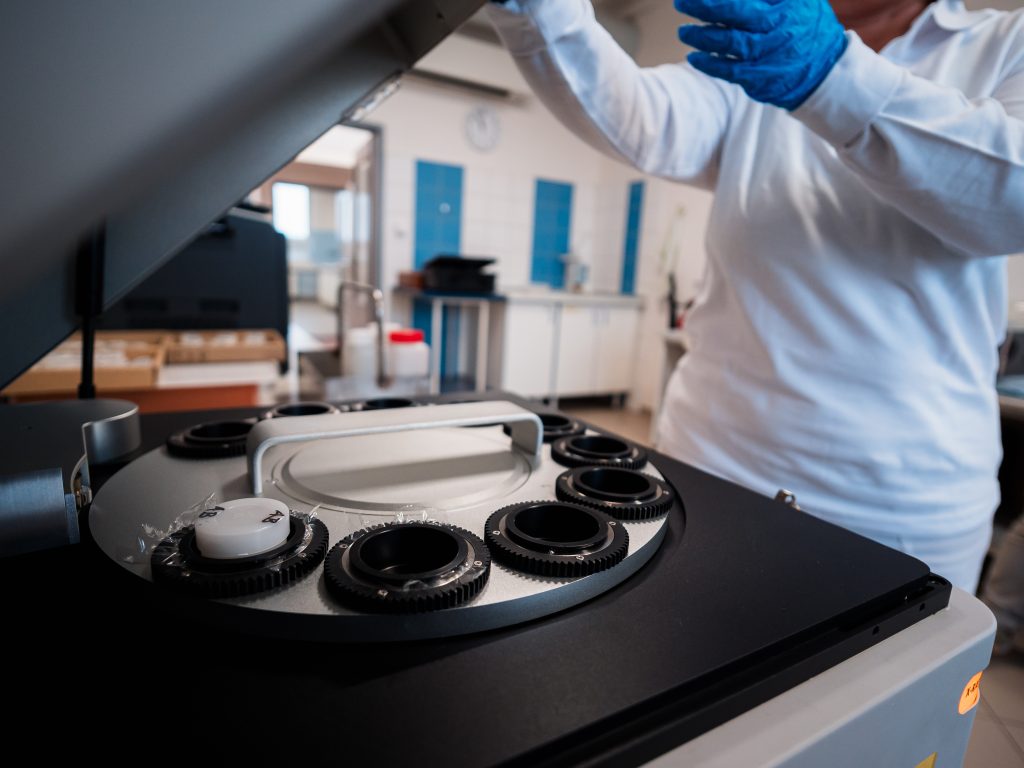
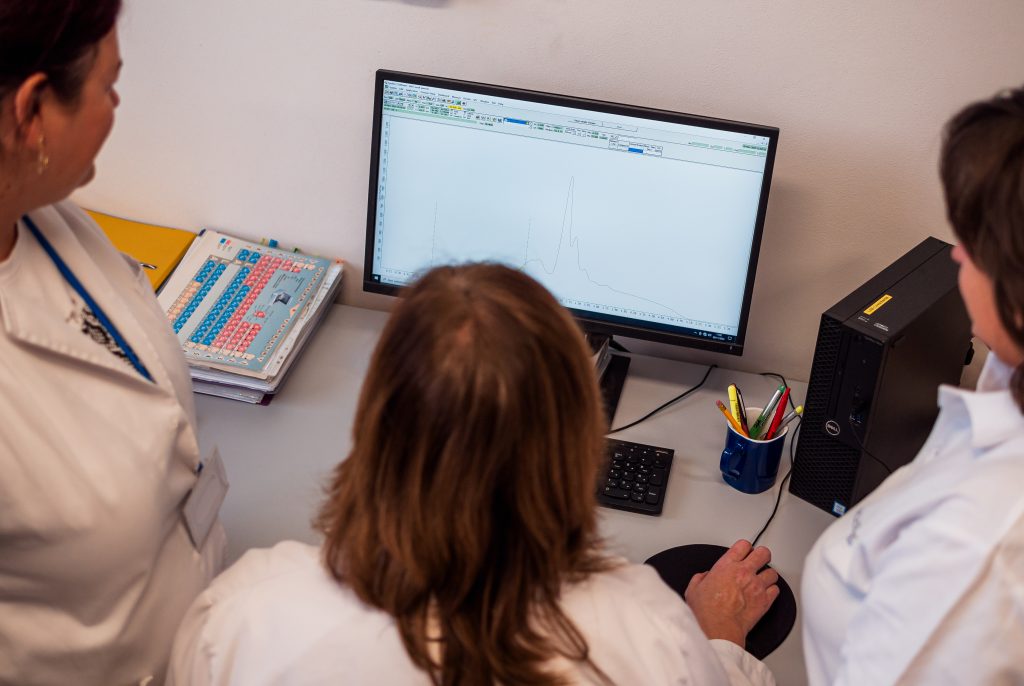
Every delivery to our customers is analysed according to ISO 22241 standards & its certificate of analysis (COA) is available in our internal system for reference. Every production batch is fully traceable back to its origin. GreenChem AdBlue is ISO certified on Quality & Environmental management systems according to ISO 9001:2015 & ISO 14001:2015 standards.
ISO Certificates:
Do I need AdBlue in my car?
AdBlue® is mandatory in Diesel cars since the 1st of January 2017. If your car is less than 2 years old and is a Diesel car, then yes you might need to add some AdBlue® in it!
To make sure this is the case, you simply have to check your user manual.
You can also check AdBlue consumption according to your car model here.
Why do I need AdBlue in my car?
Your vehicle needs AdBlue® to reduce NOₓ emission. Due to the stricter emission legislation, diesel engines need to have cleaner exhaust gases. NOₓ is one of the emissions that causes acid rain. To meet the Euro 6 standards for diesel engine emission the use of Selective Catalyst Reduction-technology (and thus AdBlue®) is required. The Euro 6 standards are into force from September 2014 for new passenger cars.
All commercial vehicle manufacturers have to meet the Euro 6 standards for diesel engine emission. Although Euro 5 emission standards could be met by different technologies, Euro 6 standards require the use of Selective Catalytic Reduction with AdBlue®.
Is AdBlue Hazardous?
No, Adblue® is not a hazardous substance. It has no known significant effects or critical hazards.
AdBlue® is a highly purified colourless liquid. It contains demineralized water and urea (32.5%). The raw material, urea, even occurs naturally in our digestive system. However, we strongly dissuade you to ingest AdBlue® or inhale it’s vapours, due to the risk of an allergic reaction.
AdBlue® is corrosive and can dissolve materials that are not listed as AdBlue® proof in ISO 22241. These materials could create malfunctions in your SCR-catalyst.
AdBlue and emission legislation
Is my vehicle subject to this emission legislation?
The Euro 1-6 emission legislation applies to motorcycles, heavy-duty vehicles (buses, trucks) and passenger cars. However, not all vehicles are required to meet the same standards.
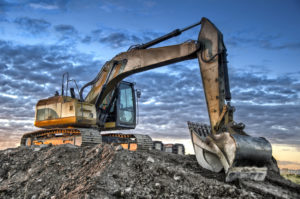
Stage I to IV legislation applies to most off-road machinery as used in construction, for farming and other applications. Whether you need to use SCR technology and AdBlue® accordingly, depends on the emission levels of your machine or vehicle.
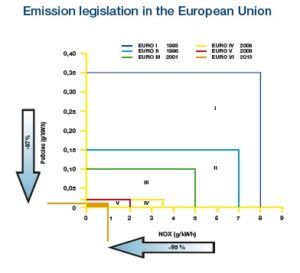
Legislation for transportation vehicles
EURO 6
Euro 6 will come into force in 2014. It will especially affect standards for diesel driven vehicles, requiring further reduction of NOx and Hydrocarbon emission. Consequently, the SCR system and AdBlue® will become vital to meet the Euro 6 standards. Euro 6 legislation will immediately come into force for trucks in January.
Newly introduced passenger cars will have to meet the legislation before September 2014 and in January 2015 all newly delivered cars will have to meet Euro 6. For more info, please refer Euro 6 Article.
EURO 5 (715/2007/EC)
Euro 5 was introduced in the EU in 2009. It proposes to limit harmful emission from Heavy Goods Vehicles (HGVs).
EURO 4 (98/69/EC, 2002/80/EC)
Euro 4 was introduced in the EU in 2005. It proposed further limiting of petrol and diesel vehicles emissions.
In Euro 4 the emission of NOx has been limited for the first time.
EURO 3 (98/69/EC)
Euro 3 was introduced in the EU in 1999. It limited diesel car emissions. Euro 3 also included legislation for Heavy Duty Vehicles.
EURO 1 & 2 (91/441/EEC, 93/59/EEC & 94/12/EC, 96/69/EC)
Euro 1 came into force in 1993, setting emission standards for commercial vehicles and light trucks. It was the start of a step by step reduction of emissions from all engines to improve air quality in Europe. Euro 1 was soon followed by Euro 2 in 1996, which included legislation for motorcycles.
Legislation for off-road vehicles
Stage III and IV and Stage IV B
Addressing a wider range of off-road vehicles. Stage III and IV contain more elaborative and demanding standards. Stage IV will be introduced in 2014. To meet these emission standards almost all manufacturers will use AdBlue®.
Stage IV B was introduced in 2011 leading major non-road suppliers towards implementation of SCR technology.
Stage I and II (1997-2004)
The first non-road diesel engine regulations were introduced in 1997. These stages did not yet include railroad engines, inland vessels or airplanes.
Where can I buy AdBlue
AdBlue is widely available in 5, 10 and 20 L cans, 200 L drums and 1,000 L intermediate bulk containers (IBCs), or through dispensing systems designed for AdBlue.
Most truck stops already sell cans of AdBlue or AdBlue in bulk. Europe also has a very extensive network of distributors and commercial suppliers of AdBlue. Look for distribution points with the AdBlue logo and fill your tank as you would with your fuel tank.
Visit the GreenChem website to find the best way to get AdBlue:
www.greenchem-adblue.com
How much AdBlue do I need?
Your AdBlue® consumption depends on your type of operation. A full tank of AdBlue® will last several tanks of diesel.
Estimated usage for trucks:
The average use of AdBlue® vs diesel for tucks is 4 to 8%.
- Local distribution:
– Approximately 500L in one year
- National distribution:
– Approximately 1,000L in one year
- International distribution:
– Approximately 2,500L in one year
Estimated usage for Passenger cars:
- Mid-class diesel (For example Opel Insignia or Peugeot 508): 1 litre AdBlue® for 1,000 km
- SUV/MPV class diesel (for example Opel Zafira or VW Touran): 1.5 litre AdBlue® for 1,000 km
Check out estimated usage and our suggestion for your car by clicking here
Estimated usage for off-road vehicles:
Because of the wide variety of off-road vehicles, it is difficult to pinpoint their exact usage. A large heavy duty tractor can use 2,500L of AdBlue® a year.
A ratio of 5 to 10% of the diesel usage is used to calculate the required AdBlue®.
Can I fill my tank up with an AdBlue pump at the gas station?
It depends, but there is the possibility to do so. Thanks to our ongoing innovations and improvements, you can now fill your car with AdBlue® at gas stations that are equipped with a GreenChem AdBlue dispensing system. Depending on the region, AdBlue® pumps at gas stations are available for both trucks and passenger cars, and can feature a smart, multipurpose nozzle with adjustable filling rates. Please check the site if this is possible.
Alternatively, GreenChem offers an extensive distribution network, making it easy for you to access our packaged products and refill AdBlue® conveniently and efficiently.
What happens if my car runs out of AdBlue?
Your car will warn you when the range for the AdBlue® tank is 2400 km. What happens after the 2400 km warning is different for each brand, so please check your owner’s manual to find out what applies to your vehicle.
For example, a Opel Zafira Tourer will warn you at a range of 2400 km. Then, the car will limit your maximum speed to 100 km/h at a range of 900 km. The car will eventually limit the maximum speed to 50 km/h and it will warn you that the engine will not restart once the engine is turned off.
Make sure you carry an emergency supply on board or continue to the next distribution point without shutting down your engine.
What do I do when I have accidentally put diesel in AdBlue tank?
If you find that you have accidentally put diesel in your AdBlue tank then Do not start your engine!
Diesel contaminates the AdBlue® and any contamination may cause costly damage to your SCR-system. It is best to contact your vehicle manufacturer to prevent any damage to your car. You may have to replace certain AdBlue® components.
If I run out of AdBlue will the engine shut down
No, the engine will not shut down, but some engines automatically limit engine performance when AdBlue® supplies are depleted.
If your engine is equipped with SCR technology, your vehicle will lose power and reduce its emission according to legal standards. The vehicle’s performance will be restored when AdBlue® levels are up again.
Note: Some engines will not start after you have run out of AdBlue®. Make sure that you have an emergency supply on board, or continue to the next distribution point without shutting down your engine.
If you want AdBlue® for your passenger car, you can know all about it from this ARTICLE and can download our APP from iTunes or Google Play by clicking on them. This is how it works:
If you have a passenger car and have any type of AdBlue® can already than here is a short video of how to refill your passenger car using a nozzle which comes with it. Check it out ->
If you are a truck or a bus company/operator, this video explains how Greenchem telemetry works to fill your dispensing systems automatically. In this, the truck or bus drivers just have to refill their tank from the dispensing system.
How do I recognise the AdBlue tank?
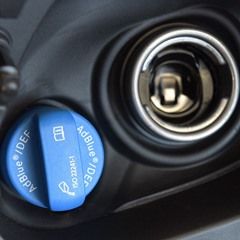
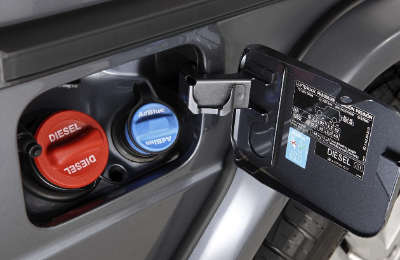
You can recognise your AdBlue® tank by its blue cap or an AdBlue® label, but it is a totally separate tank.
The filling point is often fitted near your diesel cap. Some passenger cars have an AdBlue® tank in the boot or in the engine bay.
The opening for your AdBlue® tank is narrower than the opening for a diesel tank, so you should not be able to put diesel in the wrong tank (the nozzle does not fit).
What do I do when I have spilled AdBlue®?
AdBlue® is not dangerous to the environment. A small AdBlue® spill can be diluted with water. It is best to mop up the spillage and avoid flushing it down a drain or waterway.
In case of a large spill, try to prevent the spillage from entering drains or waterways. Contain the spill with sand, earth or your spill kit and dispose of it properly. Spill kits are available in different sizes and sets.
Note: The surface on which you spill AdBlue® may become slippery. Make sure that you clean up the spill as quickly as possible to prevent slipping and falling.
Can I reuse spilled AdBlue®?
No, never try to reuse spilled AdBlue®!
Spilled AdBlue® will always be contaminated. Using contaminated AdBlue® can cause costly damage to your vehicles’ SCR system, so no matter how great the spill, you cannot reuse it!
How to store AdBlue®?
AdBlue® should be stored out of direct sunlight between -6°C and 25°C in a clean and sealed container or dispensing unit. Storing it in the wrong equipment may result in costly damage to your vehicle due to contamination, which can result in SCR-catalyst replacement and downtime.
Storage Requirements
Environment:
Check local legislation for environmental requirements. Some countries require a bunted AdBlue® storage tank when you are storing AdBlue® or an anti-spill container under the IBC or drums. Contact local authorities for further information on storage requirements.
AdBlue® Suitable materials:
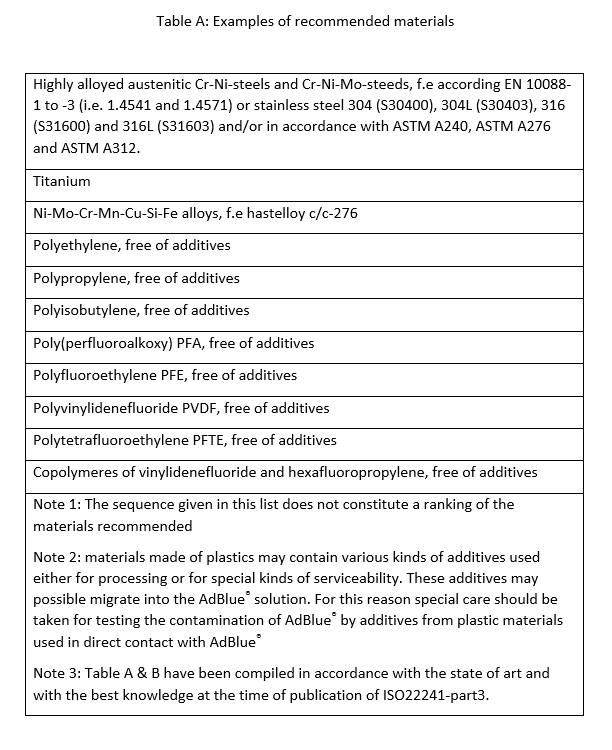
AdBlue® can only be stored in high-density Polyethylene, polypropylene or stainless steel containers. Suitable materials for piping, insulation and sealing:
- Polyisobutylene (synthetic rubber), free of additives – (for seals and hoses)
- PFA, PVDF & PTFE (Teflon) free of additives (for sheet – lining for chemical equipment/support rings, seals)
- Copolymers of (P)VDF and HFP (Viton), free of additives – (for the insulation of electrical wires & seals/o-rings)
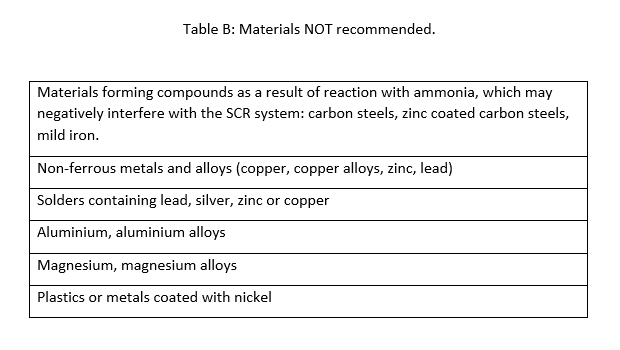
Do not use corrosive materials like copper, nickel, zinc, mild iron or aluminium. You can check the entire list in the ISO 22241 recommendations.
All materials used by GreenChem meet the AdBlue® requirements and all experience gained since the start of AdBlue® are implemented in the GreenChem AdBlue® products and available for you.
How to self verify the AdBlue quality?
Visual Test –
First, you can examine your AdBlue by visually checking for clarity, ensuring there are no contaminants or debris floating in the fluid. This will only check for color and debris in the product that could potentially clog filters on the SCR system. If the AdBlue is any color but clear, you may have a problem with mineral contamination. This method will not provide the concentration of urea to water or any mineral contaminates.
Handheld Digital Refractometer Test –
Second, you can use a digital handheld refractometer to measure the actual urea concentration of AdBlue. The urea content of good quality AdBlue should be within 31,8-33,2%. Before testing, the refractometer should be calibrated with the help of a few drops of the demin water. To get a meaningful result, it is sufficient to trickle a few drops of the AdBlue into the stainless steel tray of the device. In the sample tray, there is a prism enclosed, and thus, by means of the light refraction, the urea content is measured. The integrated light source in the digital instrument prevents measurement errors which can be quickly caused by the artificial light in the analog AdBlue refractometer. The temperature influence during the application is internally compensated by the meter. For this test, we recommend using GreenChem supplied refractometer or any other certified refractometer.
How to store & handle AdBlue?
General guidelines for AdBlue sampling
1. Be sure that the sampling point is clean. In case it’s not clean then rinse it with demin water.
2. Samples must be taken and kept in clean odorless containers made of HDPE or suitable materials such as HDPP. Metal jars may not be used for AdBlue due to the risk of contamination from metal. Samples must be protected from contamination prior to analysis. Devices used for sampling must be clean and suitable.
3. All samples must be representative of the entire batch and labeled in the following manner:
a) Product name
b) Customer name
c) Batch number of IBC / canister
d) Date & time of sampling
e) Address of the sampling location
f) Name of the person who took the sample
4. Take a clean plastic bottle of size 1 litre (preferred) or minimum 0,5 litre.
5. Place this plastic bottle under the sampling point and open the “valve” slowly. Fill the bottle halfway and close the valve.
slowly. Fill the bottle half way and close the valve.
6. Close the bottle and shake the bottle carefully.
7. Open the bottle and pour out all of the AdBlue (in a waste bottle).
8. Repeat step 4 but now just fill the plastic bottle upto 90-95% max. Make sure no insoluble/dirt particles enter the bottle from the sampling point or valve.
9. Close the valve and be sure that the plastic bottle is closed tightly.
10. Put the bottle in a plastic bag and close it carefully to prevent any possible contamination. Label the sample bottle as well the plastic bag according to step 3.
11. Prior to the analysis, these samples must be stored according to the right conditions (temperature < 25°C and not under direct sunlight).
How is the AdBlue sample taken correctly?
General guidelines for AdBlue sampling
- Be sure that the sampling point is clean. In case it’s not clean then rinse it with demin water.
- Samples must be taken and kept in clean odorless containers made of HDPE or suitable materials such as HDPP. Metal jars may not be used for AdBlue due to the risk of contamination from metal. Samples must be protected from contamination prior to analysis. Devices used for sampling must be clean and suitable.
- All samples must be representative of the entire batch and labeled in the following manner:
- Product name
- Customer name
- Batch number of IBC / cannister
- Date & time of sampling
- Address of the sampling location
- Name of the person who took the sample
- Take a clean plastic bottle of size 1 litre (preferred) or minimum 0,5 litre.
- Place this plastic bottle under the sampling point and open the “valve” slowly. Fill the bottle half way and close the valve.
- Close the bottle and shake the bottle carefully.
- Open the bottle and pour out all of the AdBlue (in a waste bottle).
- Repeat step 4 but now just fill the plastic bottle upto 90-95% max. Make sure no insoluble/dirt particles enter the bottle from the sampling point or valve.
- Close the valve and be sure that the plastic bottle is closed tightly.
- Put the bottle in a plastic bag and close it carefully to prevent any possible contamination. Label the sample bottle as well the plastic bag according to step 3.
- Prior to the analysis, these samples must be stored according to the right conditions (temperature < 25°C and not under direct sunlight).
How to clean the IBC & drums for reusage?
1. General
Following the standard handling procedure is a prerequisite for securing the overall quality of AdBlue. This procedure is prepared to secure the cleanliness of the returned IBCs and the recycling loop in order to re-use the IBC and maintain the quality of AdBlue according to ISO 22241-1 specifications.
2. Cleaning procedure
a) Check IBC (container & cage) for damages. In case of any serious damage, keep aside the IBC & inform GreenChem.
b) Empty the IBC of remaining liquid (refer picture 1).
c) Clean the IBC from outside (refer picture 2).
d) Remove all old stickers/labels (refer picture 3).
e) Clean the IBC from inside; last intensive rinse must be with pure water (i.e. demin or RO water).
f) Dry the IBC from inside (refer picture 4).
g) Test IBC for leakages, both bottom valve (see picture 5) and the container (refer picture 6).
h) Place new foil and seal on the tap at the bottom of IBC (refer pictures 7 & 8).
i) Place new IBC labels/ GreenChem sticker on the metal plate (refer pictures 9 & 10).
j) Place new blue seal on the cage and white seal on the filling cap on the top of IBC. Blue seals wont be required after their stock expires (refer pictures 11 & 12).


3. Approval process for cleaning companies
Each cleaning company that will start IBC cleaning for GreenChem, must be checked on effectiveness of cleaning as follows:
a) Place 5 cleaned and labelled IBC’s aside for transport by GreenChem to a nearby roller.
b) Toller fills the IBC’s with AdBlue.
c) Toller takes a one litre sample from each IBC.
d) Toller makes a mix sample (min. 1 litre) of the 5 samples.
e) Mix sample is analysed by authorised laboratory according to ISO 22241 – 1 specifications.
f) If all parameters are within the specification ISO 22241-1, cleaning company will get approval by GreenChem for IBC cleaning.
How does SCR system work?
Selective Catalytic Reduction (SCR) is an after-treatment technology that uses AdBlue to reduce harmful NOx emissions. The main components of the SCR system are the AdBlue dosing control and injection unit, SCR catalyst and the AdBlue tank.
AdBlue is injected from the vehicle’s dedicated AdBlue storage tank into the exhaust pipe, which is in front of the SCR catalyst, but downstream of the engine. As it is heated in the exhaust, the AdBlue changes into ammonia (NH₃) and carbon dioxide (CO₂). When the nitrogen oxide (NOx) gases from the exhaust pipe react inside the catalyst with the ammonia, the harmful NOx molecules in the exhaust are converted into harmless nitrogen and water, which is released into the atmosphere as steam.
Using AdBlue of poor quality that does not conform to the ISO 22241 standards can lead to costly repairs of SCR system.
How does GreenChem transport & distribute AdBlue?
Greenchem supplies its customers all around Europe + Brazil in two ways.
1. Bulk deliveries – GreenChem uses fully dedicated fleet of Adblue road tankers and railway cars for bulk product deliveries. By dedicating the trailers and railway cars, GreenChem customers can be 100% sure that there is absolutely no risk of contamination during the transportation. In case of regular maintenance or repairs after traffic accident is our dedicated fleet cleaned only in fully certified cleaning facilities to be absolutely sure that the cargo part of road/railway vehicle is not contaminated by any residue of service works. Our dedicated trucks are equipped with powerful pumps and hoses of proper dimensions to be able to reach any kind of tank system located at Customers premises. Part of the road tanker equipment is also calibrated flowmeter and ticket printer which allows to inform customer precisely about the exact volume of delivered product. In terms of transportation we strictly follow all ISO 22241 regulations.
2. Packed deliveries – GreenChem offers to its customers various types of packed goods, from the smallest 4L jerry cans up to biggest 1000L IBCs. All GreenChem packaging is recyclable. To be able to guarantee 100% quality of our product we use for filling only packaging directly from production, this way we avoid contamination from prefilled products. The only returnable packaging in GreenChem is IBC (please check this point with your local GreenChem seller), IBCs once returned are checked carefully, in case of any suspicion for contamination/damage the IBCs are cleaned/repaired. All openings on the IBC packaging are equipped with seals, and jerry cans/drums equipped with cap seals. In case any of these seals is broken GreenChem consider the packaging as contaminated and don´t send it to its customers. This kind of packaging is cleaned or disposed.
Handling, transportation and storage of AdBlue
Key elements of ISO 22241 part 3:
- Terms and definitions
- Shelf life: the period of time starting with the completion of the production of the batch, in which AdBlue® is stored under specific conditions, remains within the specification defined in ISO 22241-1:2006, Table 1.
- Production batch: quantity of AdBlue® produced at one operation at a site where the product has (last) been physically or chemically modified to reach compliance with the specifications as defined ISO 22241.
Note: Mixing of AdBlue® volumes does not constitute a physical or chemical modification, as long as the quality of the volumes before mixing complies with the specification given in ISO 22241-1:2006, Table 1. - Bulk operation: Handling of AdBlue® in large containers.
Note: examples of large containers are road tankers, rail cars, storage tanks and tank vessels. - Packaged shipment: handling of AdBlue® in small containers.
Note: Examples of small containers are drums, cans, bottles, intermediate bulk containers (IBCs) and totes.
- Requirements for the use of materials compatible with AdBlue®
To avoid contamination of AdBlue® and to resist corrosion of the devices used (containers, tubes, valves, Fittings, gaskets, hoses, etc.), all materials in direct contact with AdBlue® during handling, transportation and storage, (including sampling), shall be compatible with AdBlue®.
Note: In case of material with uncertain compatibility to AdBlue®: contact Quality Manager for advice.
3. Physical conditions during storage and transportation.
- General recommendation
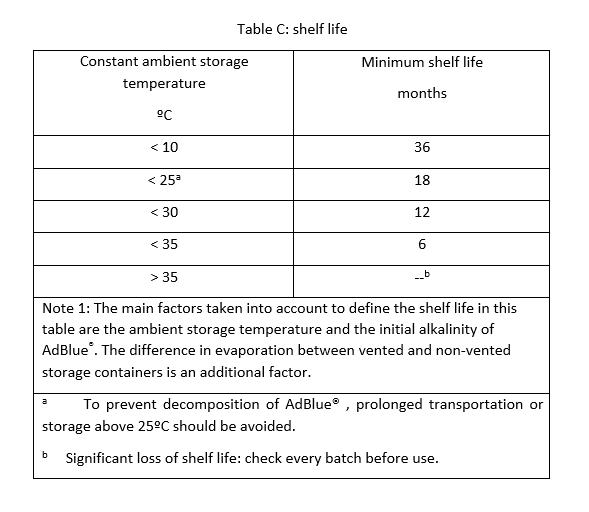
- In order to prevent decomposition of the urea, as well as the evaporation of water in the case of vented containers, prolonged transportation or storing above 25 °C should be avoided.
- In order to prevent solidification of AdBlue® storage below -5ºC should be avoided.
Note: solidified AdBlue® has an approximately 7% larger volume than the liquid and therefore, may cause a fully filled, closed container to burst. Solidified AdBlue®, which has been warmed up carefully at temperatures not above 30ºC will not be impaired in quality and can be used as soon as the warmed up solution is free from solids. - In order to avoid excessive temperature rise, AdBlue® should be protected from sunlight.
- In order to protect AdBlue® from any contamination carried by the air, well-closed containers or vented containers with filters should be used.
- Shelf life
Throughout the entire distribution chain, AdBlue® is expected to remain within the specifications given in ISO 22241-1 for at least the time periods specified in Table C as a function of the constant ambient temperature at which the AdBlue® is stored.
- Cleanness of surfaces in contact with AdBlue®
- All surfaces in direct contact with AdBlue shall be free of foreign matter such as fuel, oil, grease, detergent, dust and any other substance.
- The use of tap water should be avoided (esp. too high concentrations of Mg, Ca and Na). However if demin water is not available, it is sufficient to clean the material using tap water provided the last rinse is done using fresh AdBlue®
- Recommendation on further properties.
Information on further properties of AdBlue® should be given in the MSDS, which contains indications on the hazard ranking and regulations to be respected as well as measures required to be taken for the protection of persons and the environment when handling the product.
4. Procedures for handling of containers and equipment
- General
- All handling equipment for packaged shipment and for bulk operations should be dedicated or thoroughly cleaned and proven clean for the use with AdBlue® . The equipment should be identified accordingly.
- To avoid any contamination, dedicated containers (or proven clean) should be used.
- Temperature control means may be necessary to maintain the AdBlue® within the recommended temperature range as indicated in table C.
- The components of the filling and emptying equipment should be emptied, cleaned and closed off after use in order to prevent contamination of AdBlue® from the surroundings. Hoses, in particular, should be dedicated and closed after every use, and handled and stored in a controlled manner.
- See further QSC procedure and procedure for return IBC’s
- Single-use non-bulk containers
- Every container shall have an identification label or stamp, so that its content can be traced back to the original production batch of AdBlue® of the supplier.
- The inside of the containers should be check visually prior to the filling in accordance with a written procedure.
- During the filling of a series of small containers with AdBlue®, a one liter sample should be taken from the first container filled. The sample should be kept as a retention sample.
- Filled containers should be sealed unless the container is a vented design.
- Dedicated bulk operation.
- Means of bulk operation which are exclusively used for transportation or storage of AdBlue® need not be cleaned before loading, provided all valves, openings and hoses have been closed and handled without contamination.
- All bulk and unloading operations should be established as operating instructions with appropriate checklists.
- Prior to any loading or unloading of AdBlue® the results of the following inspections should be documented as a minimum:
- Proper closure of all valves and apertures after completion of the loading or unloading procedure
- Check of the certificate of cleanness
- Visual verification of the means of bulk transportation or storage on defects or faults
- Identification of products in accordance with the delivery documents
- In case of any irregularities during loading or unloading, the operation should be stopped immediately. A sample from the filled bulk compartment should be analyzed and based on result of analysis, proper actions to be taken.
- Non-dedicated bulk operation.
- Cleaning thoroughly prior to the use with AdBlue®
- Cleaning process takes in consideration the chemical nature of the last 3 (three) products transported.
- Documented in a certificate of cleanness.
- Prior to loading this certificate should be presented at the site of filling.
- In addition: the outlet, the inlet and the interior of the means of transportation should be checked visually.
- After loading, a sample should be taken (make sure the sample is representative for the full load)
- Non-dedicated equipment used for filling containers.
- Cleaning thoroughly prior to the use of AdBlue®
- Cleaning process takes in consideration the chemical nature of the last 3 (three) products transported.
- A sample taken from the first container filled with AdBlue® should be analyzed to confirm compliance with the specification ISO22241-1.
The products previously filled with this loading equipment and the results of analysis after the product exchange should be documented.
Do I know the quality of AdBlue by smell?
Clean and fresh urea solution is a clear, odorless liquid. However, it often happens that AdBlue starts the process of urea decomposition after some time of storage, during which ammonia is released. Even a very small amount of ammonia will cause a clearly recognizable odor. Although the decomposition of urea essentially means that the active substance in AdBlue decreases but this decrease is in most cases so small that it is not necessary to pay attention to it.
Only a more massive decomposition of urea, for example by improper storage in direct sunlight, can cause a noticeable decrease in the active substance before the end of the expiration period, ie before one year has elapsed from production.
ISO 22241 specifies in the product specification the interval over which the active substance may move, namely 31.8-33.2% of urea. This interval must be observed not only when delivering fresh AdBlue, but also during the entire shelf life, ie 1 year from production. Thus, if the active substance drops during storage from, for example, 32.3% to 31.9%, AdBlue ® is still in the specification. It follows from the above that a slight ammonia odor is usually not a defect, but it is definitely not necessary. The fresher the product you get, the less likely it is to feel right from the start.
What to do when SCR shows AdBlue failure?
Lower urea concentration or contaminated AdBlue are not the only reasons which can lead to SCR failure. The SCR system can stop working due various other reasons such as:
a. AdBlue injector: Injector seized or defective. It is no longer possible to inject Adblue into the system.
b. The Diesel Oxidation Catalyst (DOC): Burned, damaged or melted, it no longer allows optimized operation of the exhaust gas after-treatment system and little over the long term clogging the particulate filter since regenerations are no longer carried out.
c. Diesel Particulate filter (DPF): Clogged due to various causes. DOC catalyst problem, short trips too frequent and automatic regeneration not accomplished, there are multiple causes that can put your vehicle in power restriction.
d. Selective Catalytic Reduction (SCR) & Ammonia Slip Catalyst (ASC): Failure of the SCR catalyst, blocked or physically destroyed. NOx sensors can also cause SCR incidents managed by the vehicle’s ACM control module.